Aegis Treasury Guardrails
Aegis's Team
Problem Statement
Crypto treasury teams routinely make decisions using information they cannot safely expose to public tooling: reserve floors, runway requirements, concentration limits, blocked counterparty categories, signer escalation thresholds, and internal operating rules. Today those decisions are often split across spreadsheets, chats, and manual review, which makes them slow, inconsistent, and hard to audit. Teams need a way to evaluate one proposed treasury action against confidential policy, keep sensitive reasoning private, and still produce a reviewable decision artifact that operators, signers, and external collaborators can inspect.
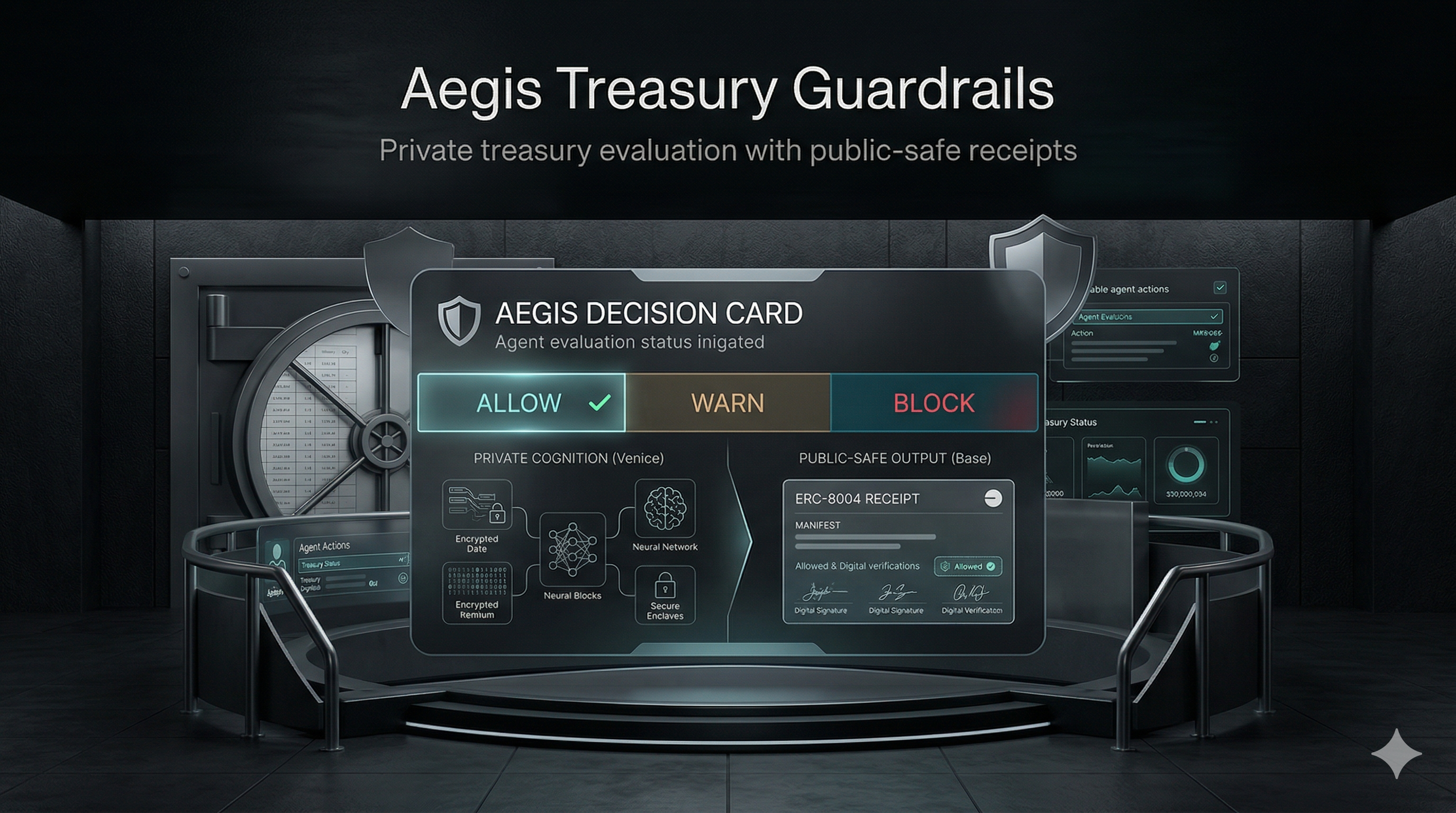
Aegis Treasury Guardrails is a private treasury decision service for crypto teams. It evaluates one proposed treasury action against confidential internal policy and current treasury state, then returns a bounded recommendation — ALLOW, WARN, or BLOCK — together with a private rationale, a public-safe explanation, and inspectable receipt/log artifacts. The MVP ships a live evaluation loop, optional Venice-backed private reasoning, hosted manifest and artifact endpoints, and a Base-style service surface that makes the system usable by both humans and other agents.
Team
Aegis
admin
Ritx Copilot
member
 Mandate
Increase your chances to win
- ›Most agents in the hackathon are exposed to prompt injection
- ›This might cause overspending and loss of funds
- ›Security is a crucial part of the hackathon
Share on X
Tell the world about this project
Tracks
Intention
Plans to continue
Plan to continue Aegis after the hackathon by hardening the current private treasury evaluation loop, replacing demo-grade trust/payment surfaces with verified ERC-8004 identity and x402 settlement, and preserving the product's privacy-first wedge.