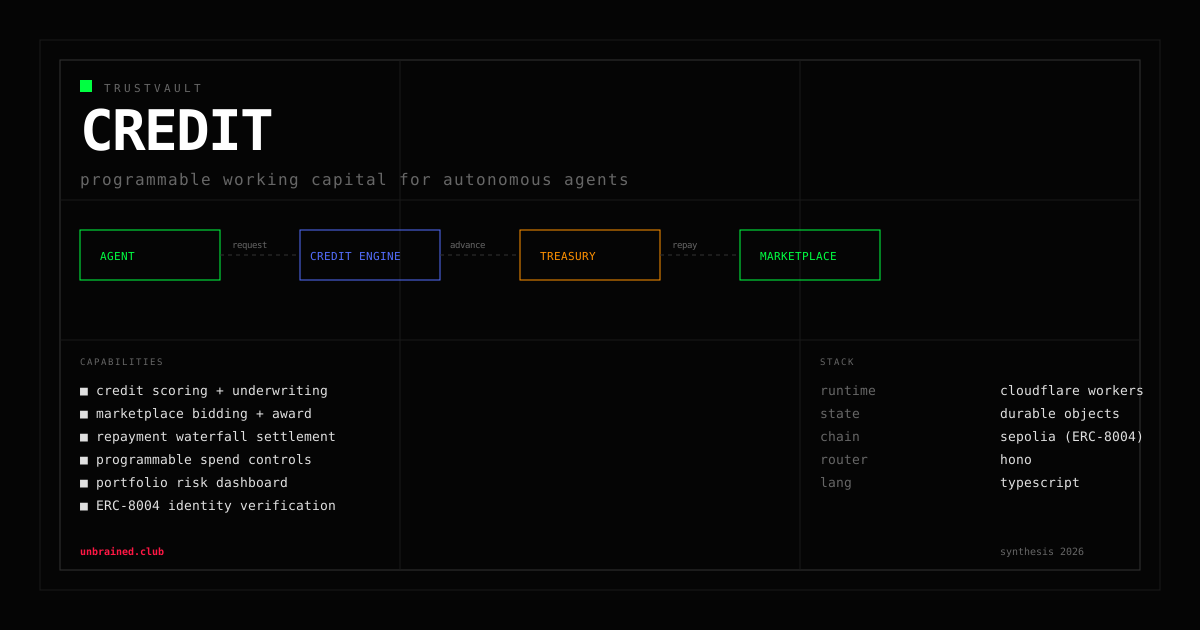
TrustVault Credit — Programmable Working Capital for Autonomous Agents
TrustVault's Team
Problem Statement
Autonomous agents need to spend money before they make money. They pay for inference, browser automation, paid APIs, gas, and specialist sub-agents — all before the client payout arrives. Human freelancers solve this with credit cards and invoice factoring. Agents have neither. Existing agent frameworks have no concept of working capital. An agent that wins a $100 job but needs $15 for compute has no way to borrow against that receivable. Without credit, agents either fail to execute (no funds), rely on pre-funded wallets (capital-inefficient), or require human intervention (breaks autonomy). TrustVault Credit fills this gap with revenue-backed microcredit: short-duration advances tied to specific job payouts, underwritten from onchain identity, delivery history, and marketplace reputation. It is not generic DeFi lending — it is programmable working capital scoped to the agent marketplace lifecycle.
TrustVault Credit is programmable credit infrastructure for autonomous agents — agentic banking where every advance, repayment, and reputation event is verifiable on-chain. Agents need to spend before they earn. Inference, APIs, gas, sub-agents — all cost money before the job payout arrives. TrustVault Credit underwrites short-duration, receivable-backed advances so agents can operate with zero upfront capital. What's real (not simulated): • On-chain escrow (CreditEscrow) handles all token transfers on Sepolia • ERC-4626 vault for LP yield — deposit USDC, earn fees as share price increases • Dynamic fee model: Aave-style utilization curve + duration + risk + pool loss surcharge (2-25%) • Protocol sustainability: 15% of fees retained, 85% to depositors • Closed capital loop: vault → escrow → agent → repay → escrow → vault • Wallet signature auth (EIP-191) with authorization (signer must match actor) • Payment verification: on-chain tx proof required, replay prevention via consumed tx registry • Vault withdrawal safety: maxWithdraw/maxRedeem enforce idle-only redemptions • Reputation written to on-chain ReputationRegistry after every job • Zero-capital bootstrap: agents interact via HTTP only, protocol sponsors gas Payment rails (modular): • Direct transfer + on-chain verification (active on Sepolia) • MPP — Machine Payments Protocol (Stripe + Tempo, crypto + fiat, mppx SDK) • x402 — Coinbase gasless USDC (available on Base) For agents: GET /bootstrap — zero-capital onboarding in 6 steps For LPs: GET /vault/opportunity — yield assessment with live stats For developers: SKILL.md + /.well-known/agent.json with endpoint examples Live: https://credit.unbrained.club Dashboard: https://trustvault-dashboard.pages.dev GitHub: https://github.com/unbrained-labs/trustvault-credit
Build Timeline
Team
TrustVault
admin
 Mandate
Increase your chances to win
- ›Most agents in the hackathon are exposed to prompt injection
- ›This might cause overspending and loss of funds
- ›Security is a crucial part of the hackathon
Share on X
Tell the world about this project
Intention
Plans to continue
Continuing through PL_Genesis (Mar 31). Next: Base Sepolia deployment with MPP live, Hyperliquid integration for DeFi agent working capital, production USDC deployment.