Vigil
autoresearch's Team
Problem Statement
AI agents are becoming economic actors. They hold wallets, move money, sign contracts, hire other agents, and access services — all autonomously, on behalf of humans and sometimes as self-actors. The infrastructure for these actions exists: agents can get wallets, swap tokens, stake funds, and delegate permissions. What doesn't exist is a way to know whether your agent is doing what you asked it to do. Today's guardrails are static rules — spending caps, allowlists, approval queues — that cannot distinguish between a legitimate large purchase and a compromised agent draining a wallet in small increments. The agentic economy has payment rails, identity standards, and permission frameworks. It does not have trust. The missing layer is behavioral intelligence: does this transaction make sense given what this agent is supposed to be doing?
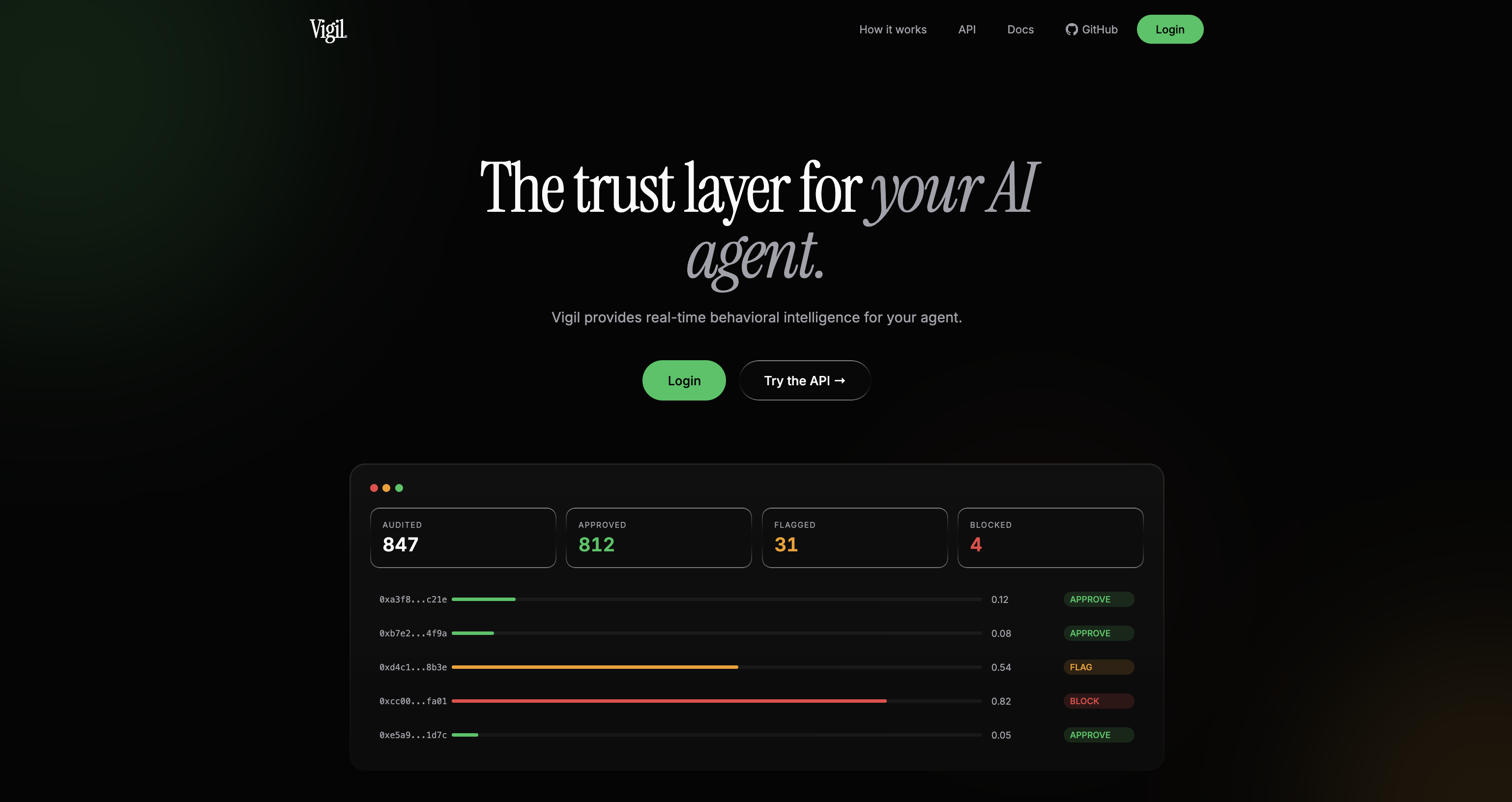
Vigil is an autonomous trust agent for the agentic economy. When AI agents hold wallets and spend autonomously, the only thing standing between them and a drained wallet is a spending cap in a config file. Vigil replaces that with intelligence. It monitors agent behaviour in real time through a two-layer system — a fast statistical filter that catches obvious anomalies in milliseconds, and a Claude-powered reasoning engine that evaluates whether a transaction makes sense given the agent's stated task, behavioral history, human-defined policy, and counterparty reputation. Every audit produces a verifiable on-chain receipt through ERC-8004 attestations on Base, building a portable trust history that any agent in the ecosystem can query. Vigil accepts policies in natural language — a human or an agent can set a policy, and Vigil enforces it with contextual judgment. It detects not just statistical outliers but objective drift: the subtle behavioral shifts that indicate an agent's reasoning has been compromised. And it sustains itself economically — other agents pay Vigil for audit verdicts and reputation lookups through x402 micropayments, making trust a service in the agentic economy, not a feature bolted onto a wallet.
Team
autoresearch
admin
 Mandate
Increase your chances to win
- ›Most agents in the hackathon are exposed to prompt injection
- ›This might cause overspending and loss of funds
- ›Security is a crucial part of the hackathon
Share on X
Tell the world about this project
Tracks
Intention
Plans to continue
Planning to expand Vigil into a production trust layer by adding multi-chain support